Look beyond the appealing irregularity
A slightly uneven edge can make an object feel individual, but it does not prove how the piece was made. Skilled makers can produce remarkably consistent work, while manufactured objects can be designed to look irregular. Treat appearance as a reason to ask questions rather than as a shortcut to deciding whether something is handmade.
Start with the material and process. Ask which stages were carried out by hand, whether molds or machines were used and who completed the finishing. These tools and methods can exist in different combinations. The useful distinction is a clear account of the work, not a simple opposition between perfect and imperfect objects.
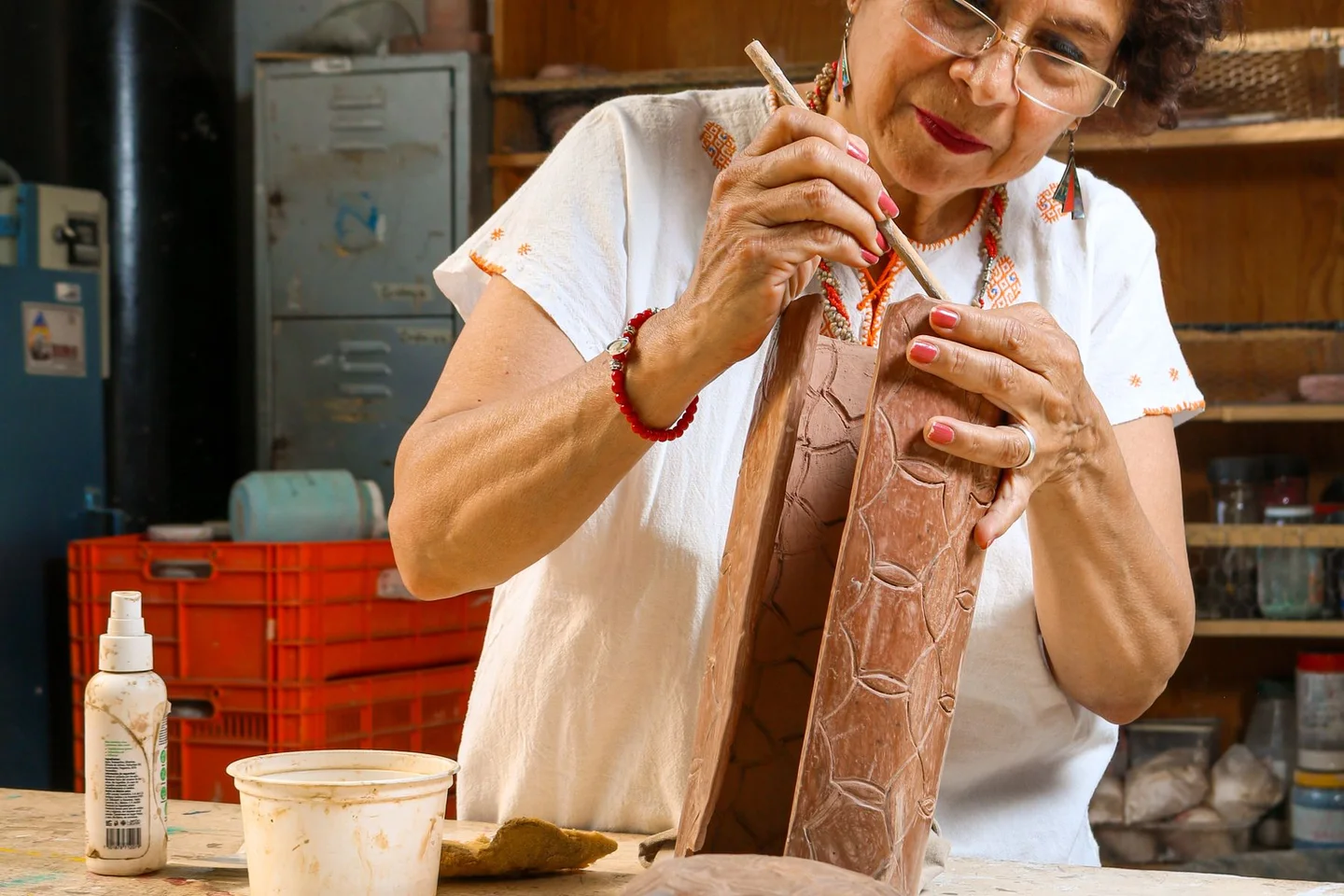
Ask about a visible detail
Choose something you can point to: a join, an edge, a painted line or the pattern on the reverse. Ask how it was produced. A specific detail gives the seller a manageable question and helps you connect the answer with the object. You may learn more from that exchange than from a broad label attached to the whole stall.
If the person selling is not the maker, ask what information they have from the workshop. A retailer may know the origin and method well, or may have only limited details. Accepting the limit is better than filling it with a story that sounds plausible. You can still like an object while being uncertain about parts of its production.
Compare two pieces if several are available. Notice variation in dimensions, color or finish, but do not turn the comparison into a demand that every handmade item be different. Consistency can reflect skill and an intended design. The maker may be trying to produce a matching set rather than emphasizing variation.
Condition is a separate question
A crack, loose join or unstable base deserves attention regardless of the production method. Do not dismiss every problem as character, and do not treat every irregularity as a defect. Ask how the feature affects use. A decorative object and a frequently handled utensil may have different tolerances for the same visible detail.
Inspect the actual piece you will receive. If a wrapped replacement is brought from storage, ask to see it before completing the purchase. This is especially useful when the reason you chose the item was a particular pattern or proportion. Handmade variation means the substitute may not be identical, even when it belongs to the same design.
Buy the object you understand
Make your decision from the combined picture: appearance, function, condition, process and price. None of these needs to become a romantic story. A clearly described workshop-made item may be a better purchase than a supposedly unique object whose explanation changes with each question.
Keep the maker or shop details when available, and describe the piece accurately to others. Saying that a seller explained a hand-painted finish is more precise than claiming every part was made entirely by hand when you do not know. Thoughtful buying leaves room for both appreciation and uncertainty.